
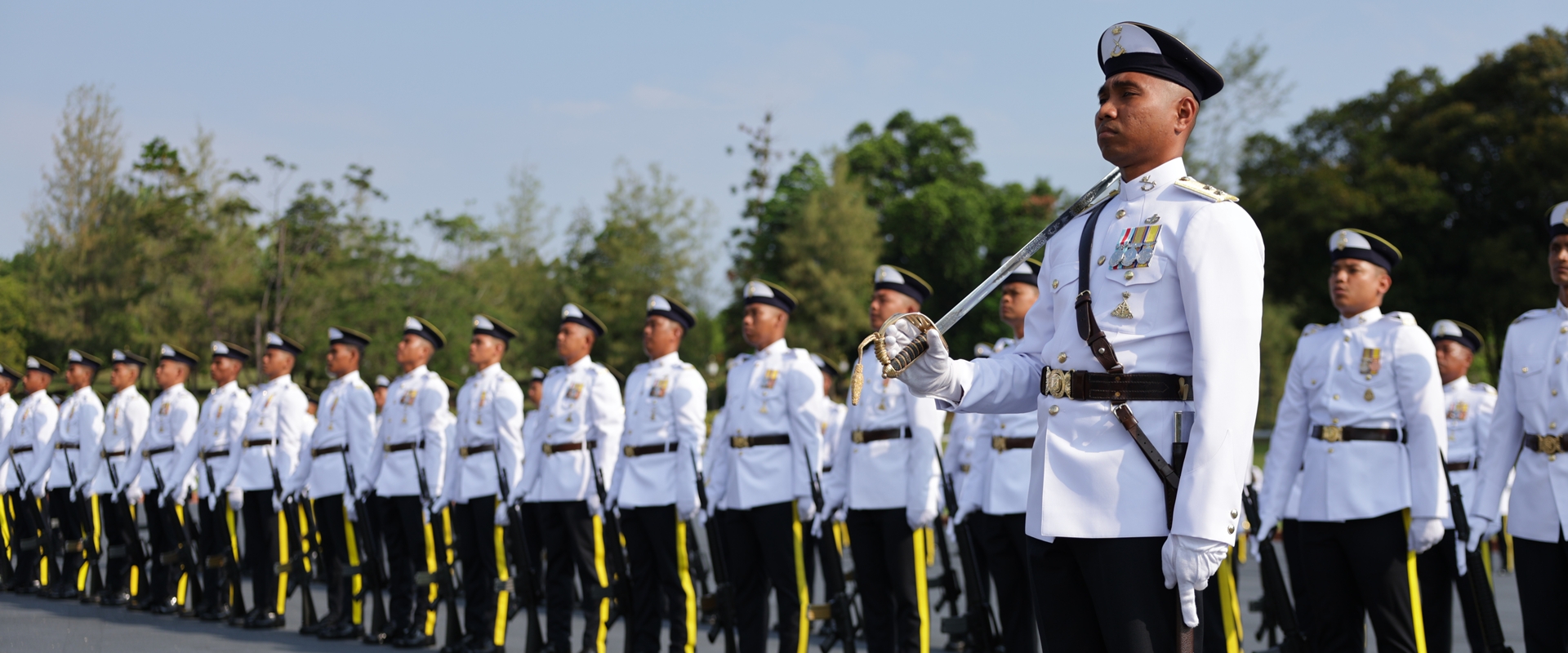
1. DEPUTY LOYAL TO THE STATE
"This unit, known as the Timbalan Stia Negri was at first only 60 strong and
their main duty was to assist the Police in the maintenance of order in the
state (Reference: Riwayat Johor Military Forces, pg: 23)."
After His Majesty Sultan Sir Abu Bakar left for Johor,
he ordered that 60 young Malays be selected to be constables or in Malay, called Timbalan Setia Negeri as an aid to the existing Police Force.
His Majesty agreed to appoint Syed Mahmud bin Nong Yahya, a Prince of the Gulf
to be its leader (Reference: Ruwayat Johor Military Forces – The strength of the Johor soldiers from the beginning).
Before DYMM Sultan Sir Abu Bakar concluded the 1885 Loyalty Agreement
with the British government in England, he had begun to organize
the Johor Military Forces from the natives (the Johor Malays) himself, which was
known as the Johore Military Forces.
This force was led and commanded by the Malays themselves (Reference:
History of Johor, Its Relation to the Malay States, Shaharom Husain, 1995).
Then, DYMM Sultan Sir Ibrahim ibni Almarhum Sultan Abu Bakar
ascended the throne of Johor in 1895 after the death of his father, he
continued the continuation of the State Loyalty. In 1895,
his Majesty, who was in the rank of Colonel Commandant, proclaimed the name of the State Loyalty
Soldiers to the State Loyalty Soldiers (ATSN) (Reference: 100 YEARS,
1886-1986 State Loyalty Soldiers of Johor). Various competitions,
membership in parades and membership in assisting
in war were also carried out by the ATSN team at that time.
In the 19th century, the State Loyal Deputy Soldiers were later proclaimed
as the Johore Military Forces as a symbol of the modernization of the team.
Through restructuring, a law was introduced known as “Law Number 18 for the Year 1915”. There were
several positions introduced such as Commandant, Court Marshall, enemy, military
prize, offense and others (Reference: 100 YEARS, 1886-1986 ATSNJ).
2. JOHORE MILITARY FORCES MODERNIZATION
A) The Existence of the Bras Band 1882 to 1985
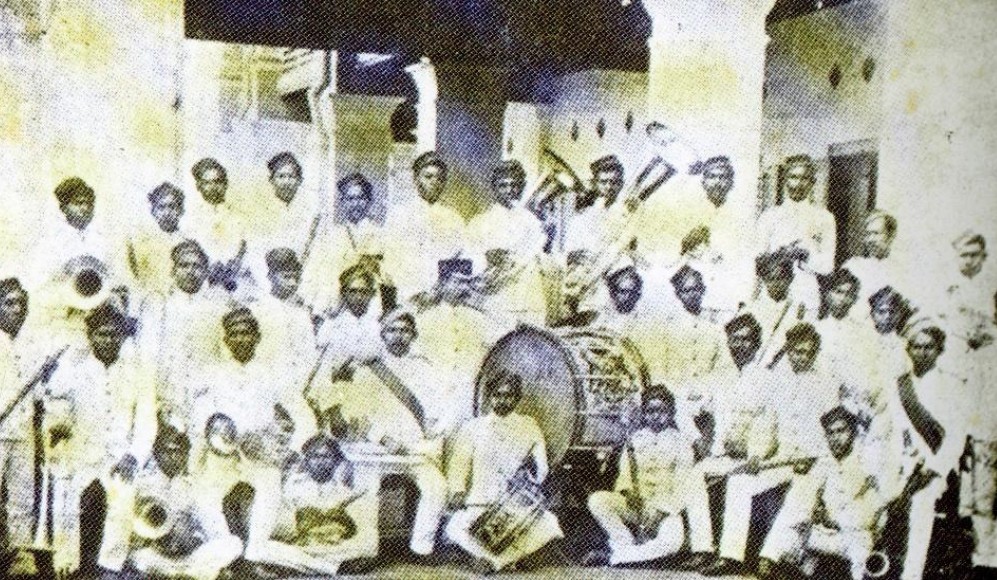
The Johor State Deputy Loyalty Soldiers' Band 1896
In 1882, DYMM Sultan Sir Abu Bakar established a band unit known as the Bras Band which was played at Teluk Belanga during the Johor Royal Wedding Festival. This band unit was composed of Malay children and a Dutch teacher named Golistan. Then, after Golistan retired, the band unit was handed over to Drum Major Awang bin Yahya who was skilled in the field of music. The band was then led by a Band Master who had served with the British Regiment in 1935 named Wright. He served until the arrival of the Japanese in 1940 (Reference: 100 YEARS, 1886-1986 Johor State Deputy Loyal Soldiers). In addition, the band unit was briefly rested until the end of the Second World War and returned to active service in 1978. Mohamad bin Jonid, with the rank of Waren Officer 2, led the team before being taken over by Major Mohamad Anuar bin Alaidin as the Music Director. Therefore, important ceremonies such as the Birthday Anniversary of His Majesty the Sultan, the Awarding Ceremony of Johor Medals and Honors, Official Ceremonies of the State and Malaysian Governments, as well as in 1985 accompanying the Birthday Ceremony of the Sultan of Kelantan and being invited to perform at the Malaysian Armed Forces Council in Kuala Lumpur have also involved this band unit.
B) Establishment of Law Number 18 for the Year 1915
DYMM Sultan Sir Ibrahim has established a law regarding
the conditions of service of the ATSN or Johor Military Forces known as
"Law Number 18 for the Year 1915". This law was recorded
in the Government Gazette dated 15th December 1915. Among the matters
contained in this law are the interpretation of terms such as Commander, Court Marshall, enemy, military prize, offenses and others.
This Johor Military Forces Law of 1915, is complete for the purpose of
making the ATSN a military institution that can fulfill
the clauses in each service such as recruitment, discipline,
offenses, officer duties and others. In the state of Johor, this law is printed using Jawi script and words and terms are spelled in Jawi script as well, such as "duty", Regimental Order, Military
Record, Superior Officer, State Prisoners and others (Reference: History Exhibition Book in Commemoration of the 100th Anniversary of ATSNJ 1886-1986 by, Ahmad bin Hj.
Samion and Mohd Ayub bin Hj. Noor).
C) Conversion Ceremony 1916 to 1935
1. Exchange of the 1916 Flag
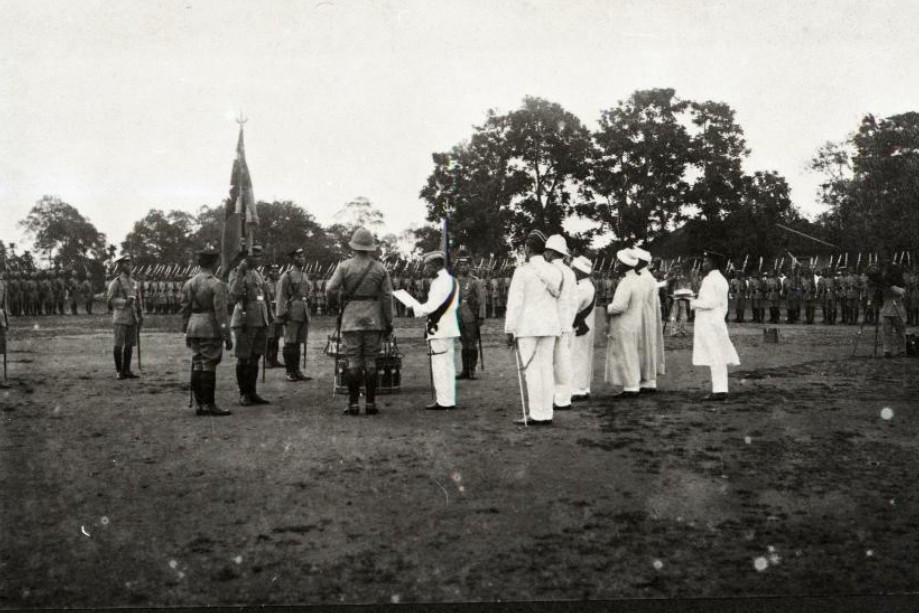
Exchange of the 1916 Flag
On 11 May 1916, the exchange ceremony of the awarding of the flag by the late Sultan Sir Ibrahim took place. The first flag was shaped like the flag of the state of Johor. It could be strengthened when it was rectangular and there were 3 main colors, namely (red, white and blue). There was a crescent and a white star in the left corner which symbolized the sovereign King of the State of Johor. The red color around the crescent and star meant the chieftain of the ATSNJ while the dark blue meant the Government of the State of Johor. The flag is surrounded by a yellowish brown flagpole and the flagpole has a spear pattern and its head is decorated with a crescent moon and star motif (Reference: Johor State Deputy Setia Soldiers 130 Years of Setia Bekidmat by Kamdi Kamil, p. 50).
2. Exchange of the Banner 1935
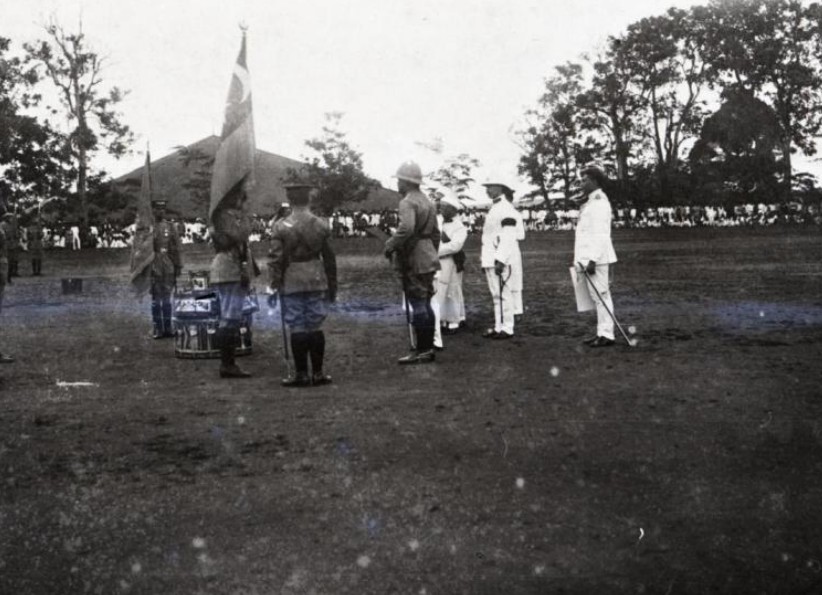
Exchange of the Banner 1935
On 7 September 1935, a ceremony was held to award the banner and the flag at Padang Baris Bukit Timbalan, where all the volunteers from all over Johor gathered. The ceremony took place in front of Johor Malay officers, whites and prominent relatives of the state, all of whom were present in full uniform and wearing the prescribed ranks. The handing over of the penpanji was DYMM Sultan Sir Ibrahim, witnessed by Yang Amat Mulia Sultanah Helen, Yang Berhormat Mulia Ungku Abdul Aziz (Menteri Besar), YB General Adviser and representing the volunteers was Major Yang Amat Mulia Tunku Mahkota, Major Yang Amat Mulia Tunku Temenggong and organized by Major YB Dato'Awang. Dualagi namely volunteer Captain Yang Amat Mulia Tunku Aris Bendahara and Major YB Dato' Haji Mohd. Said (Staff Officer) could not attend The ceremony continued with the band and program supervised by Lieutenant Colonel YB Dato' Yahya bin Abu Talib, followed by a tea party in front of the JMF Officer Mess and a rice party for all volunteer members, and ended with a special play by the Singaporean puppet group (Reference: Hikayat Johor yang Kedua, Tawarikh Duli Yang Maha Ibrahim Sultan Johor Dari Permulaan sihka Kedangan Jepon (1941) p. 174).
3. 1986 Flag Exchange
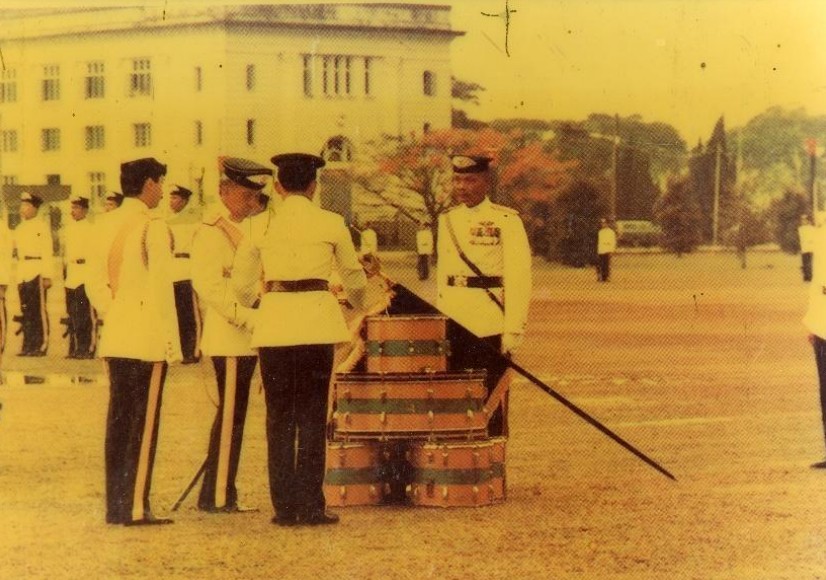
1986 Flag Exchange
The Flag Exchange Ceremony on 20 August 1986 by DYMM Sultan Iskandar at Padang Istana Besar, Johor Bahru. There were 180 officers and other members of the ATSNJ rank led by Captain Dato’ Othman bin Daud (Deputy Commanding Officer) on duty during the handover of the 1986 Flag. This second flag is not the same as the flag in 1916. This can be proven, this second flag has Jawi writing which is “Allah Peliharakanlah” and below it there is a crossed sword and keris. Above the sword and keris there is a Crown which symbolizes the reigning king while the keris is a traditional Malay weapon and the sword is a traditional Western weapon ((Reference: Deputy Setia Soldiers of Johor State 130 Years of Loyalty Bekidmat by Kamdi Kamil, p. 51).
4. 2016 Flag Change
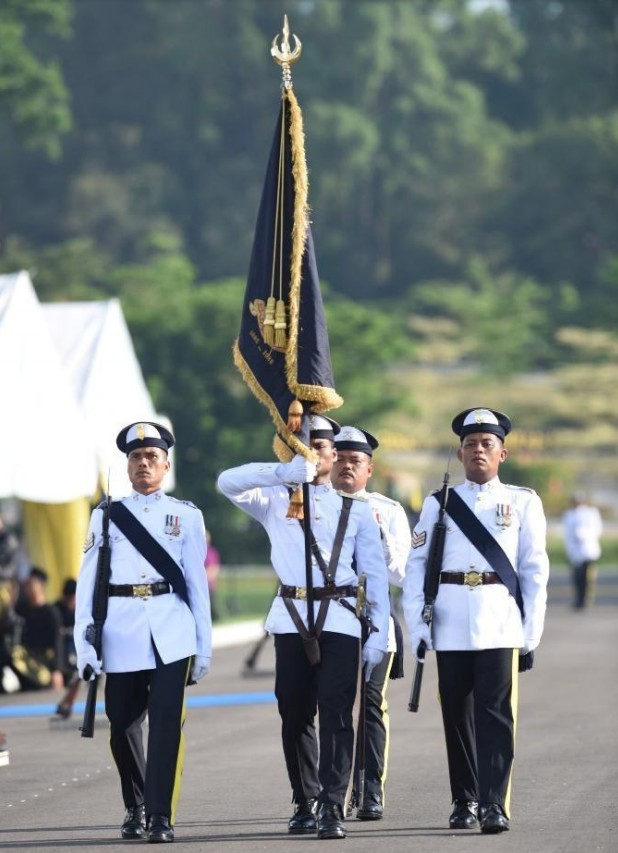
2016 Flag Change
The 2016 Flag Change ceremony took place on 11 May 2016 at Dataran Istana Besar, Johor Bahru Johor. A total of 190 personnel and 8 officers were on duty during the change of the 1986 Flag to the 2016 Flag. Among the officers involved were Major Hj. Jalalludin bin Hj. Hamsan (Head of Parade), Captain Md Sukri bin Ahmad (Assistant Head of Parade), RSM Moharam bin Hj. Hamad (RSM Parade), Lieutenant Ahmad Hamdan bin Libar (Head of Detachment Number 1 Head of Detachment), Lieutenant Mohamad Farhan bin Hj. Kamaludin (Head of Detachment Number 2 Head of Detachment), Second Lieutenant Mohamad Nor Helmi bin Mohamed Amin (New Standard Officer), Second Lieutenant Mohamad Shafiq bin Md. Zabi (Old Standard Officer) and Second Lieutenant R. Raffi Ramzee bin Abdul Rheman (New Standard Bearer Quartermaster Officer) (Reference: Johor State Deputy Setia Soldiers 130 Years of Service by Kamdi Kamil, p. 57).
D) RECEIVING A MEDAL OF AWARD FROM THE BRITISH GOVERNMENT
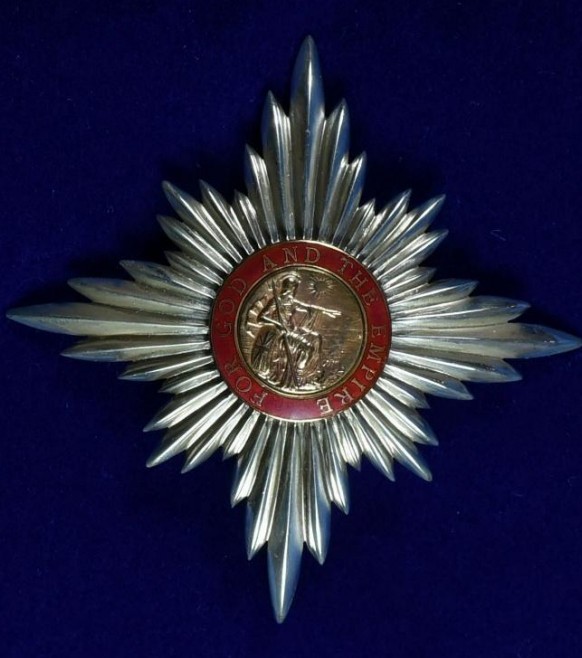
Honorary Knight Commander Of The Most Excellent Order Of The British Empire (K.B.E)
On 6 March 1918, His Majesty DYMM Sultan Sir Ibrahim was awarded the Order of the K.B.E. by the British Government at Padang Bukit Timbalan Johor Bahru. The installation of the medal was installed by the Governor of Singapore (Reference: Book
Historical Exhibition in Conjunction with the 100th Anniversary of ATSNJ 1886-1986 by, Ahmad bin
Hj. Samion and Mohd Ayub bin Hj. Noor).
In addition, there are 3 members of ATSNJ whose names were listed in the
London Gazzette for their service to the British Government on 13 March 1918.
Among the names listed are Colonel Commander Yang Maha Mulia Ibrahim
the Sultan of Johor, Major Ab. Hamid bin Yusof (Second In Command), Kapt. Haji
Mohd. Said bin Haji Sulaiman (Staff Officer) (Reference: Historical Exhibition Book
In conjunction with the 100th Anniversary of ATSNJ 1886-1986 by, Ahmad bin Hj. Samion and
Mohd Ayub bin Hj. Noor).
E) JOHOR MILITARY FORCES SENT TO TRAIN AT INDIAN MILITARY ACADEMY, DEHRADUN, INDIA
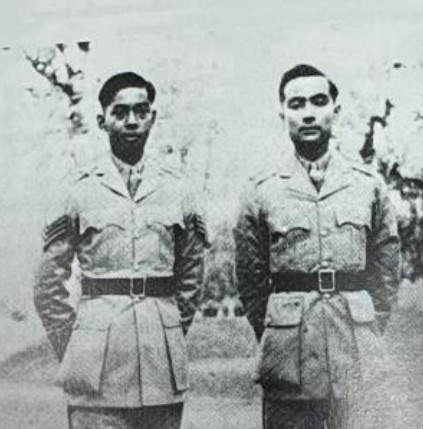
Tun (Capt.) Hussein Onn with General (Rtd) Tan Sri Dato' Ibrahim Ismail taking a commemorative photo while attending the Dehra Dun Military Academy in India in 1941.
Several ATSN officers were sent as the first group to receive special training in Dehra Dun, India. Among the selected officers were, Yang Mulia Tengku Abdul Jalil bin Mohd. Noor,
Major Yahya bin Haji Yusof, Major Abdul Jabar bin Jaafar and Raja Ahmad bin
Ali. For other members, further training was given by
British military officers who were specially brought from Singapore.
In addition, on 19 July 1941, the second group of Cadet Officers was sent to
the Dehra Dun Military Officers Academy, India. Among the officers involved were
Ibrahim Ismail, Hussein Onn and Ungku Ahmad bin Ab. Rahman. (Reference:
Historical Exhibition Book in Conjunction with the 100th Anniversary of ATSNJ 1886-1986 by,
Ahmad bin Hj. Samion and Mohd Ayub bin Hj. Noor).
3. INTRODUCTION TO JOHORE VOLUNTEER FORCE (JVF), JOHORE VOLUNTEER RIFFLES (JVR) & JOHORE VOLUNTEER ENGINEER (JVE)
1. Johore Volunteer Force (JVF)
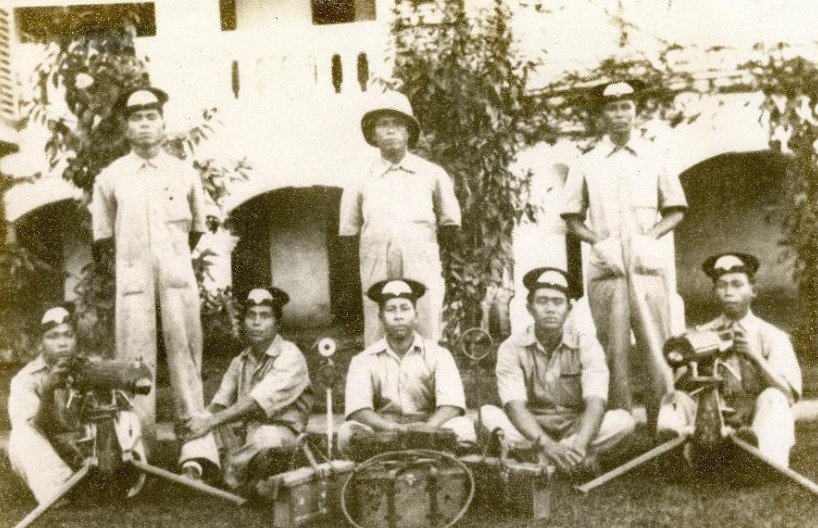
Johore Volunteer Infantry (Cannon Force)
In 1905, DYMM Sultan Ibrahim established a volunteer force which was initially known as the “Johore Volunteer Infantry” and later the “Johore Volunteer Forces (JVF)”. The purpose of the establishment was to make this force a body to train the Johor Malays as government
administrative officers. In addition, the JVF was established to facilitate exchanges between the
ATSNJ and the JVF since officers with military
training were more disciplined and could increase their authority (Reference: J.M.
Gullit, Rulers and Residents, Influence and Power of the Malay States 1870-
1920).
The JVF team also participated with the ATSNJ in the
celebration of King Edward's birthday in Singapore. The team
expanded to the districts of Mersing, Segamat, Batu Pahat, Muar and Pontian.
The team defended the ATSNJ Headquarters during the First World War
when the ATSNJ was deployed to defend Singapore. On 7
September 1935 Sultan Sir Ibrahim granted the
JVF team a banner in a ceremony attended by, among others, YM Sultanah Helen, Tunku
Mahkota Tunku Ismail and Menteri Besar Ungku Abdul Aziz bin Abdul Majid
(Reference: ATSNJ official website)
2. Johore Volunteer Rifles (JVR) & Johore Volunteer Engineer (JVE)
The Johore Volunteer Rifles were established under the Johore European
Volunteer Enactment No. 11 of 1915. Its members are Europeans, and
they are liable for service in any part of the
Malay Peninsula or the adjacent islands. The corps, which has a strength of
8 officers and 166 other junior officers, and is armed with
M. L. E. rifles, is under the jurisdiction of the Governor of the Straits Settlements
(Gabenor Negeri-Negeri Selat), and its officers hold letters of appointment
from him with the consent of the Sultan. The corps is called up for
active service by the Governor, but, in cases of great emergency in the
State of Johor, it may be called up by the Sultan with the consent of the Counsel General
to the Government of Johor. When on active service or undergoing
training or drill with the Regular Force, the Rifles are subject to the Army Act,
except that the death penalty shall not be imposed and no other punishment
may be carried out. (Reference: Website: dervins.uk: Armaments Year Book,A. Military Forces, p.189)
The Johore Volunteer Engineers were formed from European members,
and were only liable to serve in the State of Johor and also, if
in time of emergency the Governor so orders with the consent of the Sultan, in
any part of Malaya; or to serve in any part of
the Malay Peninsula. The corps, which was one field company strong, and was armed with Lewis rifles and machine guns, was under the authority of the Governor of the Straits Settlements, and its
officers held letters of appointment from him with the consent of the
Sultan. The Corps is called up for active service by the Governor, but in
cases of major emergency in the State of Johor, it can be called up by the Sultan
with the consent of the General Counsel of the Government of Johor (Reference: Website:
dervins.uk: Armaments Year-Book,A. Military Forces, p.198).
4. THE STRENGTH OF THE JOHOR MILITARY FORCE (JMF) INVOLVED IN THE CURRENT WAR IN SINGAPORE AND WORLD WAR II
It all started with the Johor Military Forces members helping to guard
at Tangling Singapore, everything went well, suddenly on 15 May
1915 at about 4.30 pm, a call was received to Bukit Timbalan, the Indians Fifth
Light evening Infantry who were guarding there rebelled and
shot people from the Johor side, three people were killed, then they got another
from Head Quarters asking for help. Therefore, among the casualties were
However, Captain Cullimore, Captain Abdul Jabbar bin Abdul Samad, and
Private Yaacob bin Salleh were killed in the battle (Reference: CO
273/420/75, Riot at Singapore, p. 394).
During the Second World War, the state of Johor was invaded by
the Japanese army in 1942. Several forts were
established to maintain security. Among the areas involved were
Tanjung Pengelih and Parit Sulung. However, in 1942
the General Officer Commanding The Troops Malaya also recommended
that the JMF members be disbanded in order to avoid being detained by the
Japanese (Reference: Hikayat Johor yang Kedua, Tawarikh Duli Yang Maha
IbrahimSultan JohorDari Permulaan dhika Kedangan Jepon (1941) p.
175).
5. RESTORATION AND RE-EXISTENCE OF THE JOHORE MILITARY FORCES (1941-1948)
Through Clause 8, on 8 December 1941, the Japanese
declared war on the United Kingdom and the United States. The arrival of the Japanese
in Johor resulted in the British advising Sultan Ibrahim to
withdraw and seek refuge in Singapore because Japan was increasingly advanced
in terms of military and defense. The British advised that the
Soldiers and Volunteer Forces be disbanded. In addition, the Japanese
came to meet Sultan Ibrahim at Istana Plangi to advise
him to move to Batu Pahat for refuge. However, on
15 February 1942 the British were held at Changi and the Japanese ruled the whole of Malaya until September 1945. The disbandment of the
Johor Military Force and Johor Volunteer Force could be seen as not being used until September 1945 because the Japanese were still in Malaya and the
Japanese occupation ended following the defeat of Germany in Europe.
(Reference: History of Johor Military Forces, pg: 18).
Next, on 6 January 1942 four companies of the ATSNJ
under the command of Lt. Col. Musa bin Yusof were sent to take over the task of
the Australian army controlling the communications equipment in Kota Tinggi and
preparing the defensive fortifications there. When the Japanese army bombed Kota
Tinggi and Johor Bahru two weeks later, the GOC advised Sultan
Ibrahim to disband the ATSNJ since the Japanese army had invaded
Malaya and was moving south, and the Commonwealth army was retreating to
Singapore. At first Sultan Ibrahim refused to accept the advice but
was eventually forced to disband the ATSNJ to save its members and
their families. ATSNJ, which controlled Kota Tinggi, Mawai, Mersing, Lenggor
and Kahang, were heading back to their hometowns for safety. Sultan
Ibrahim admitted that ATSNJ members were reluctant to retreat, but they
upheld his Majesty's order to disband. (Reference: Website: Johor State Deputy Soldiers)
Then, on 28 January 1942, the Malayan military government requested
His Majesty's consent to disband the ATSN and Volunteer
Johor due to the war tactics. This proposal was accepted by His Majesty and
all weapons were handed over to the British soldiers so that they could not be captured
by the enemy. The British soldiers were also preparing to retreat to
Singapore. All ATSN and Volunteer members were asked to take refuge in safe places, bringing their families. Those involved were Ibrahim
Ismail, Hussein Onn and Ungku Ahmad bin Ab. Rahman. (Reference: Book
Historical Exhibition in Conjunction with the 100th Anniversary of the ATSNJ 1886-1986 by,
Ahmad bin Hj. Samion and Mohd Ayub bin Hj. Noor)
Finally, after the end of World War II, the British wanted to
change the existing status quo by introducing the Constitution of the
Malayan Union. This idea was opposed by the Malay government and people. On 1
February 1948, a new constitution called the Federation of Malaya was proclaimed. The terms of the constitution were that the Federation of Malaya would only have one army at the federal level to defend the sovereignty of the country. Therefore, the role of the JMF was reduced to a focus on safeguarding the security of the Sultan of Johor and his assets and the strength of these members was limited to about 100 men. The force was given a new name, the Sultan's Body Guard. However, Sultan
Ibrahim did not agree with the name and wanted the JMF name to be retained.
His proposal was well received by the British. Sultan Sir Ibrahim also
took over as the JMF government. The JMF's role as the security guard of the Sultan of Johor and the palace remains to this day.